Problem 7.8 (20 pts.), 7.15 (20 pts.), and 7.28 (40 pts.)
Meeting with visiting candidates (10 pts. each; more details to come)
-
Lunch Monday November 16, 2026
-
Lunch Tuesday November 17, 2026
-
Lunch Wednesday November 18, 2026
Hints:
-
Problem 7.28:
-
You may find it easier to do part (b) first and find the density of states g(ϵ) for the two-dimensional electron gas. You should find that g(ϵ) is a constant,
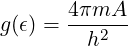
-
Once you have the density of states, it is easy to calculate N and U. Note, for example, that at T = 0,
N = ∫ 0ϵF g(ϵ)dϵ U = ∫ 0ϵF ϵg(ϵ)dϵ The first equation means that you can rewrite g(ϵ) =
 .
-
You may skip part (c). At T = 0, μ = ϵF . At low, but non-zero temperature in 2 dimensions, it turns out that μ is still ϵF .
-
For part (d), note that the chemical potential is effectively defined by Eq. 7.53 for a given N and T. Part (d) involves a messy integral. If you define

then you should have an integral which evaluates to
∫ x0∞  = ln(1 + e-x0
)
(If you want to prove that result, multiply the top and bottom by e-x, and then make the substitution y = 1 + e-x. Or you could just use the result given above.)
-
For part (e), you should get a result that looks similar to Eq. 6.93, but you need to replace the ratio
 by an analogous result for 2 dimensions:
 .
-